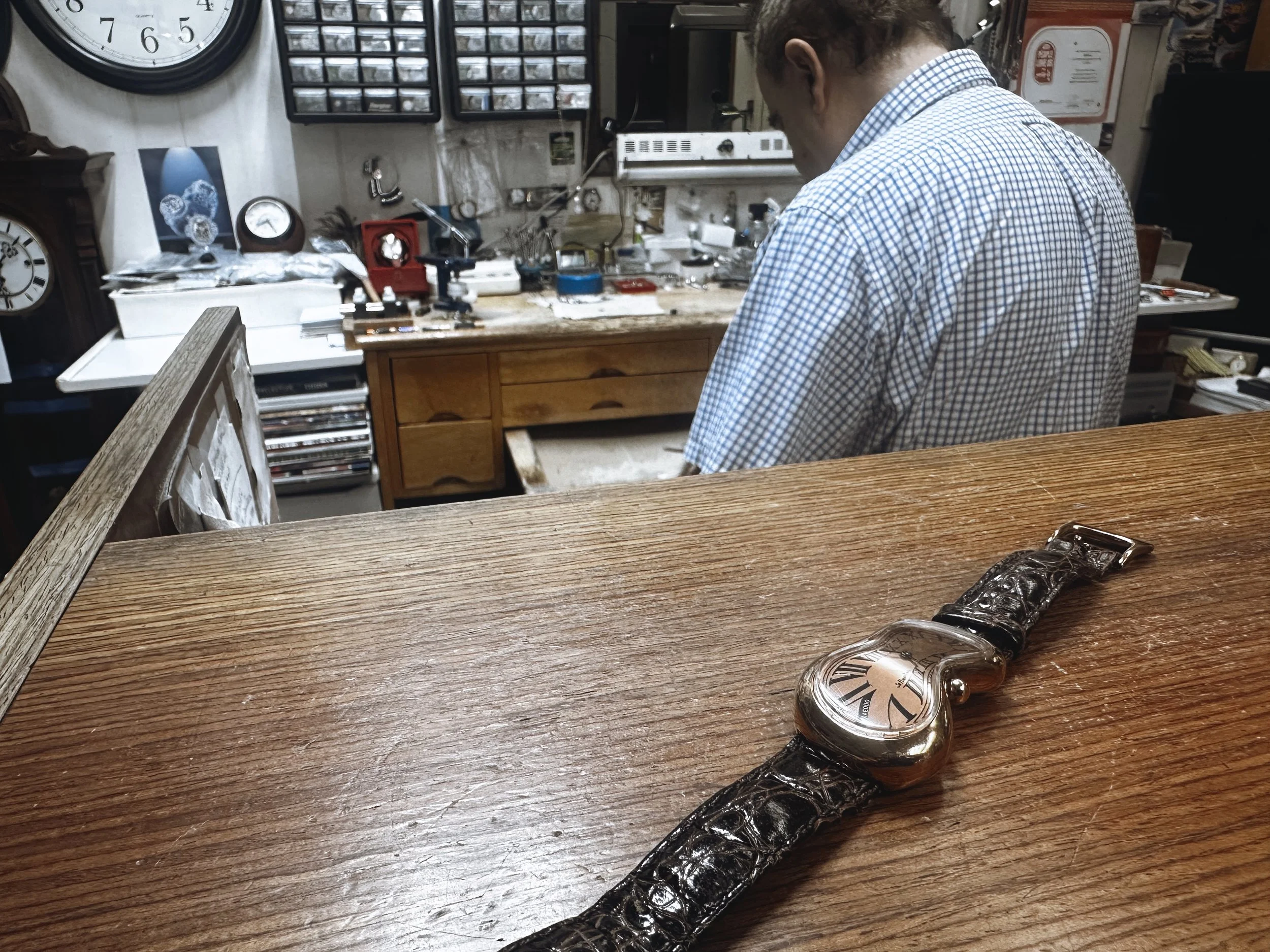
A watch dial is a small argument about time. Twelve numbers, evenly spaced. Sixty minutes, each the same size as the last. Two hands moving predictably between them, insisting that every hour is exactly as wide as the one before it.
It is a confident claim, and we have been making it for centuries.
The Exaequo Softwatch begins by undoing all of that.
Its shape bends and drifts, as though the rules holding an ordinary object together had loosened just enough to let something stranger through. Nothing is where you expect it. Everything still belongs.
That, of course, is the point.
The Softwatch appeared in Switzerland at the start of the 1990s, but the image it borrowed was sixty years old. In Salvador Dalí’s 1931 painting The Persistence of Memory, clocks have lost their rigidity. They sag over branches and fold across hard surfaces. Time itself has surrendered its shape. Dalí returned to them in 1952, in The Disintegration of the Persistence of Memory, and by most accounts it was that later canvas that Philippe Muller saw in New York in 1989.
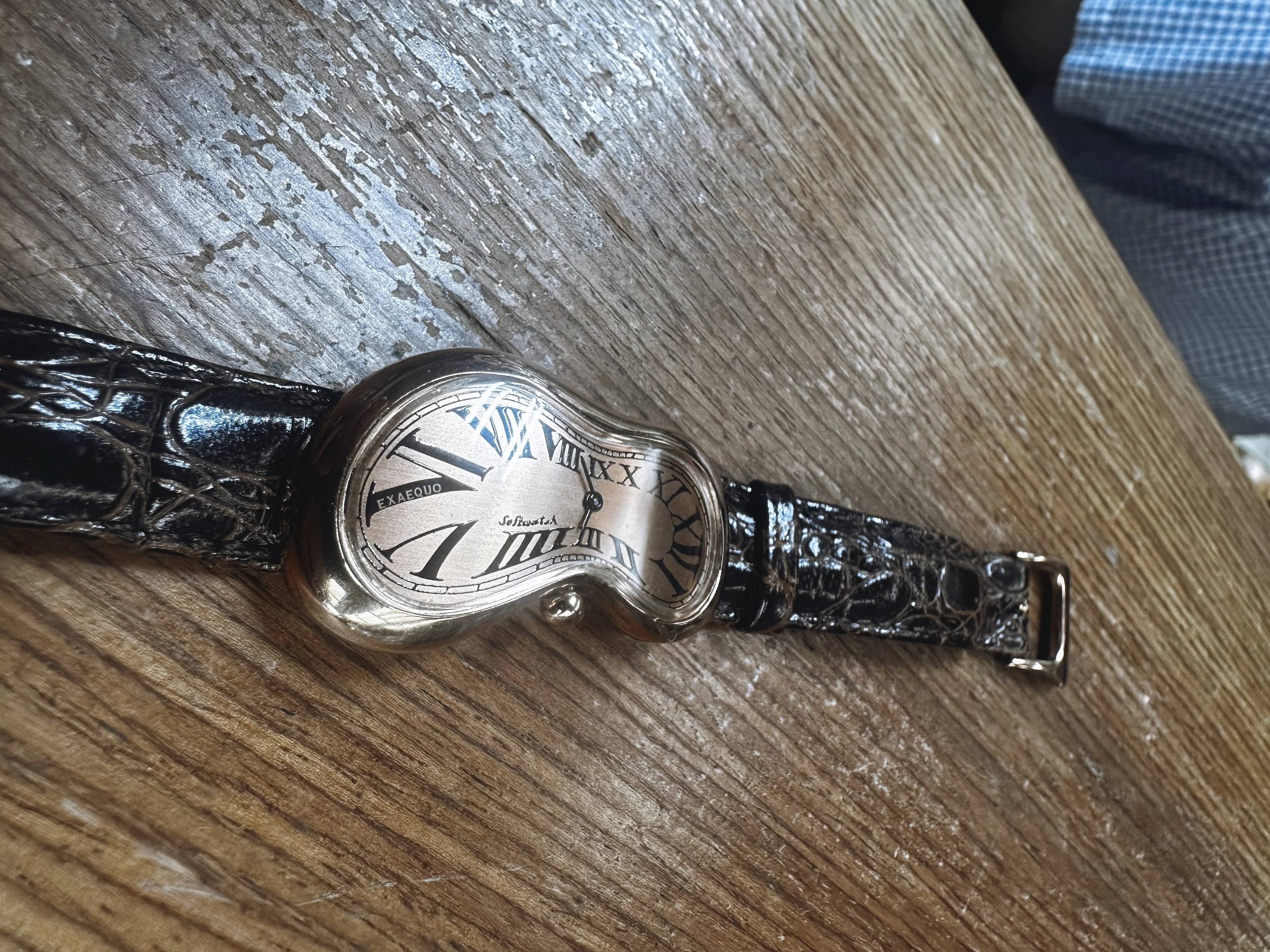
Muller founded Exaequo in Geneva the following year and put the painting on a wrist: gold-plated cases, warped Roman numerals, colorful straps, a quartz movement ticking beneath all that surrealism. It was never Cartier or Rolex, and it had none of the century-old mythology that watch brands are so good at polishing.
Its story would soon become as distorted as the watch itself.
The version that survives in collector lore is simple: Exaequo made a watch inspired by Dalí, Dalí’s people objected, and the Softwatch disappeared. The beginning was friendlier than that. Muller approached Robert Descharnes, who administered Dalí’s commercial rights through a company called Demart, and came away with a license. Exaequo built the watches for Demart, and they sold in museums and galleries alongside the rest of the Dalí merchandise. The earliest examples carried no name at all. Later dials carried Dalí’s, and then his signature.
What went wrong is harder to establish. The arrangement broke down over the right to use Dalí’s name, and by the end of the 1990s Exaequo was finished. The brand faded. The watches did not.
For years they circulated without much of a story attached — surfacing in estate sales and online listings, sometimes identified, sometimes not, their history growing less certain as they passed between owners. There were no famous wrists to point to, no auction results establishing importance, no endless stream of images confirming desirability. You could encounter the watch before anyone had told you what to think of it.
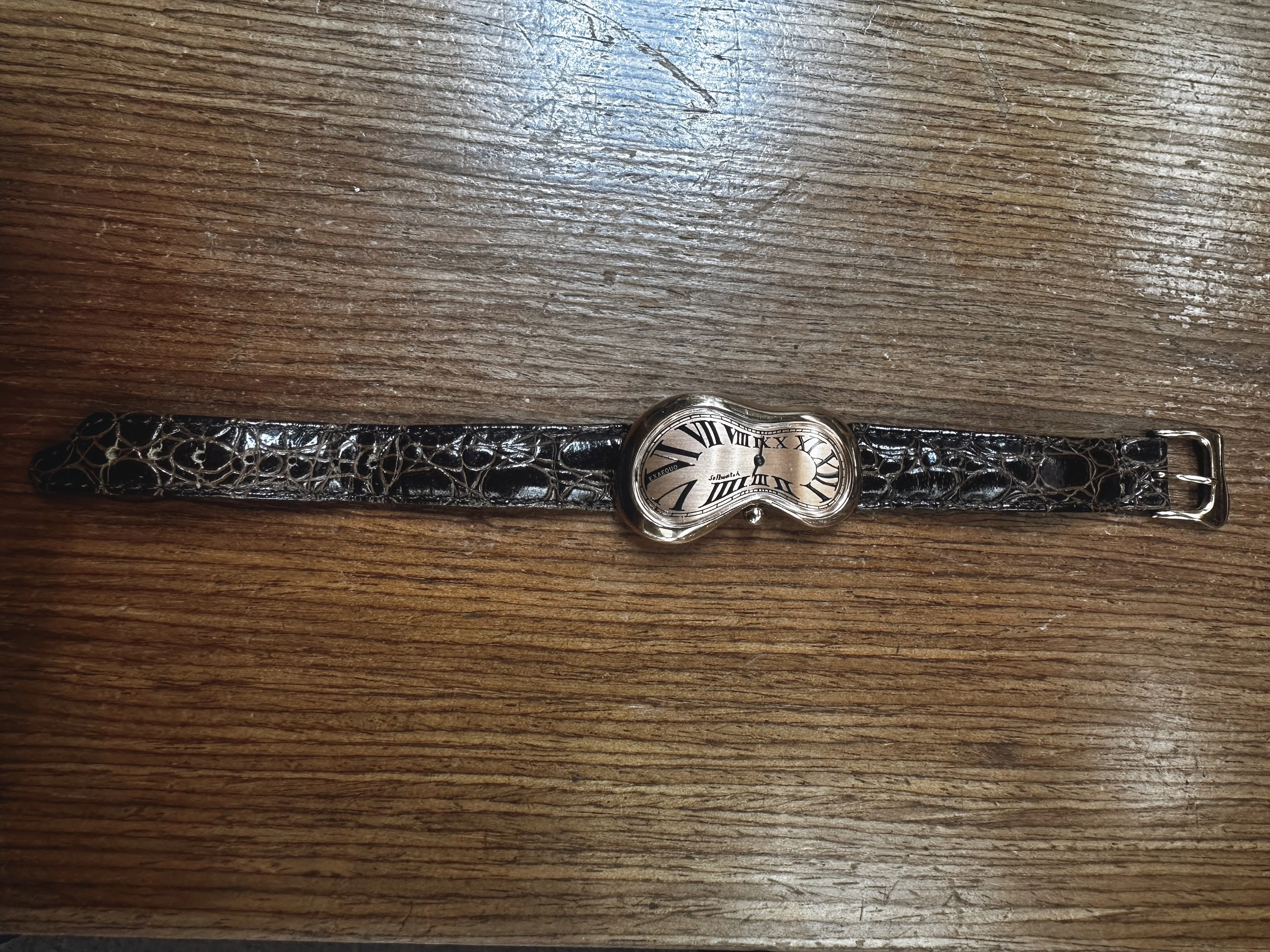
More than two decades earlier, Cartier had already warped the familiar shape of a watch. Introduced in London in 1967, the Crash became an icon of watch design. The resemblance is obvious. The difference is more interesting.
The Crash distorts the watch. The Softwatch distorts time.
There is something almost unserious about it. Depending on the reference, it can look elegant, cheap, beautiful and faintly ridiculous at once — less an heirloom designed to become important than an idea that escaped into the world.
But what interests me has little to do with any of that.
What interests me is that the watch looks like time feels.
The dial makes its claim with total confidence.
Mechanically, it is true.
Humanly, it has never felt that way.
Five minutes spent waiting can feel enormous. Five hours with someone you love disappear. Childhood summers stretched indefinitely; years later, entire periods of our lives collapse into a photograph, a song, a smell.
Memory makes the arrangement stranger still. It does not preserve our lives chronologically. It folds them.
Something that happened thirty years ago can feel startlingly present, while the years between vanish. A moment we barely noticed while living it becomes the one we remember. Something we tried desperately to hold onto disappears almost completely.
Time stretches. It contracts. It disappears. It returns.
The perfectly round watch shows us none of this.
The Softwatch does.
Here is the complication. Dalí never claimed any of it.
Asked directly whether the soft watches came from Einstein and the relativity of time, he said they did not. They came, he explained, from a Camembert melting in the sun.
It is exactly the kind of answer he liked to give — deflating, a little absurd, impossible to argue with. And it means the most famous image of time’s instability may have been an image of lunch.
The meaning arrived anyway. Relativity. Entropy. Dream time. Exaequo put the watches on a wrist in 1990 and sold them as surrealism. None of those meanings required Dalí’s permission.
Which may be the more honest version of the argument. We did not find our experience of time inside the painting. We brought it, because we needed somewhere to put it, and the image was soft enough to take the impression.
The Softwatch looks distorted because we have grown accustomed to seeing time drawn as orderly. Consider it long enough and the melting version starts to look like the accurate one.
We invented clocks to measure time.
Nobody said that was how time would feel.