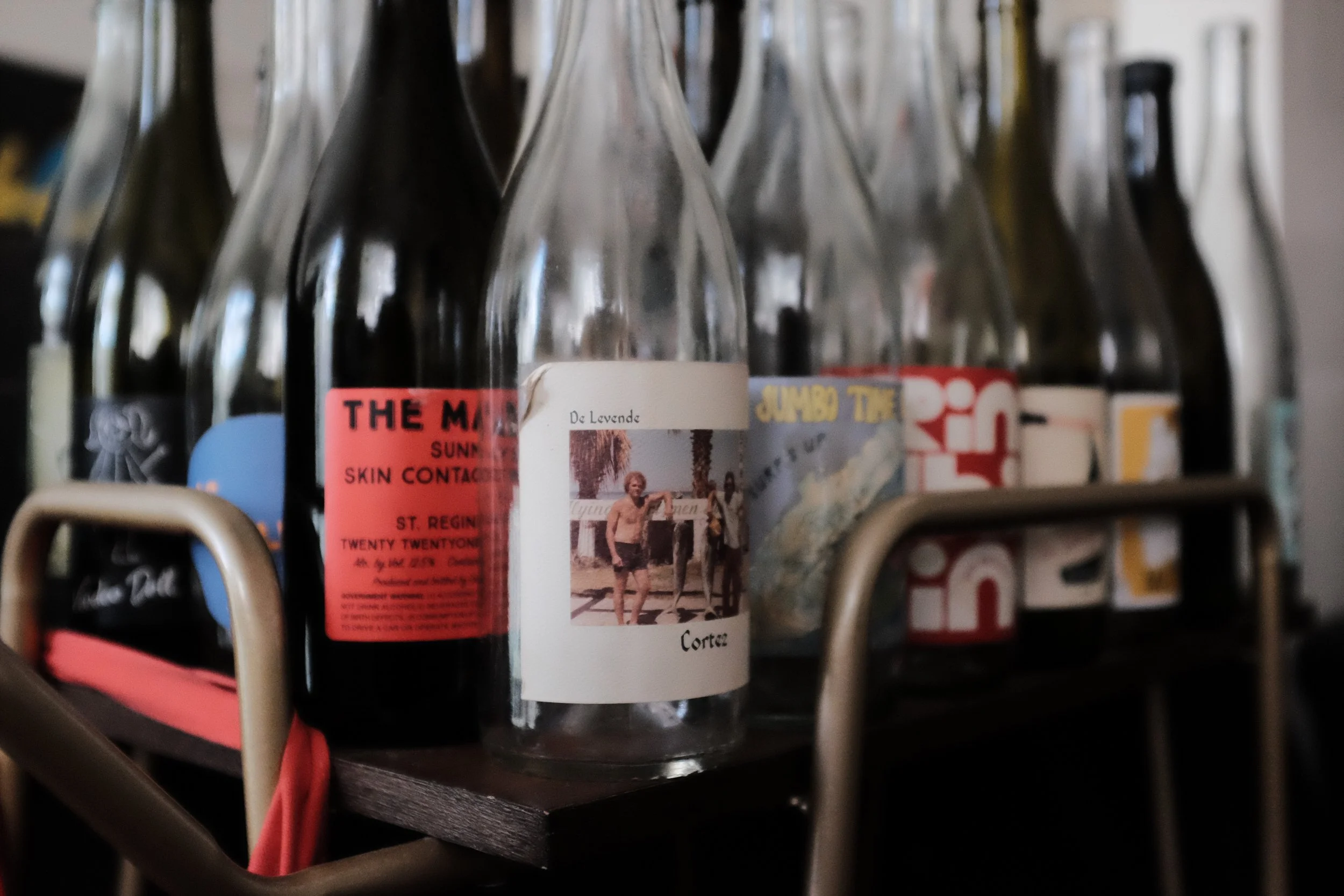
There is an empty bottle on a shelf in my kitchen.
It has no value. It isn’t rare, it isn’t collectible, and I couldn’t sell it for the cost of the cork.
A De Levende Cortez. Krystle and I drank it before we knew much about wine. I poured it at one of the first Twilight Fridays, back when I was buying the bottles myself. De Levende sent us a few cases this year. Chloe, Peggy, Clay and Nicole poured it.
I could describe what was in it. The description would be accurate and it would miss entirely, because what I kept the bottle for isn’t the wine.
A Refined Curatorial has been quiet. The world around it has not.
Over the past couple of years, while fewer stories appeared here, Friday evenings at Roosevelt got busier. A few friends walking nine holes became a few dozen. Bottles accumulated. Tee times filled.
This publication began as a place for the things I found interesting: music, fashion and style, food and drink, sports, and art. The subjects changed, but the impulse was usually the same. Find something worth looking at, look a little closer, and share what I found. It was a publication about culture.
Then we started making some of our own.
Roosevelt Wine Club grew out of the same interests. Wine, obviously. Golf. But also music from a speaker on somebody’s cart, clothes we liked, bottles we wanted other people to know about, photographs being taken while nobody was paying attention, and a group of people who seemed to understand why all of it belonged together.
The people were never a byproduct of the thing. They were the thing.
There are only a handful of us behind RWC. What began as people helping me with something I had started became a small team building it together, and somewhere between the tee times, the late-night texts and the bottles carried around a golf course, some of them became my closest friends.
I hadn’t planned for that. I hadn’t planned for much of what followed.
The Wine Classic was one of those things. It was an idea we described to people before it existed, and Paul and Elena at Fallen Grape said yes before anything was concrete. They came out, we poured together, and by the end of the night it wasn’t an idea anymore.
And it kept happening. Winemakers gave us bottles before they knew what we’d do with them. Brands gave us their names. Other clubs wanted to make things together. People showed up, came back, brought someone new.
Somewhere in there I stopped asking: Will they understand this? Will they take us seriously? Do we belong here?
The questions are still available to me. I just stopped looking around to see if anyone was convinced, and started paying attention to what we were making instead.
The flattering version of the last two years is that ARC was never really quiet. That it was out gathering material, living the stories it would eventually publish, doing research in the form of Friday evenings.
It’s a good story. Parts of it are true.
The rest of it is that I stopped writing.
Not because the work had moved somewhere else. Because writing is slow and solitary and difficult, and there was always a tee time to book, a bottle to move, a text to answer, a thing to plan. Twilight Fridays were easier. They also gave me something writing almost never does, which is other people, immediately.
Two years of that isn’t research. Some of it is just two years.
The bottle was empty when I picked it up off a table. Torn label, somebody’s thumbprint in the dust on the shoulder. Everything that made it worth keeping happened outside the glass.
I brought it home anyway.
That is most of what keeping things is. You decide something mattered, and then you leave it where you’ll see it.
We started putting things on shirts for much the same reason.
Rosey Los Angeles grew out of Roosevelt Wine Club almost as naturally as RWC grew out of ARC. The people, photographs and references around the club started finding their way onto clothes. One of the shirts is a drawing of the Roosevelt clubhouse with its shutters down.
By the time we finish, it’s always closed.
That was never the end of the evening. We sit on the benches, open another bottle, wait for the last group to come in.
The shirt doesn’t contain any of that. Neither does the bottle.
An idea can be interesting on its own. You can write about it, photograph it, turn it over until you understand something you didn’t before.
But an idea changes when other people enter it.
A bottle becomes the night it was opened. A golf course becomes the people you walk it with every Friday. A drawing of a closed clubhouse becomes everything that happened after it closed.
None of that is in the object.
It arrives with the company.
Culture works the same way. The objects matter because people decided they did. Because somebody wore them, opened them, played them, passed them around, kept them.
I spent two years away from this publication surrounded by exactly that.
Some of it was worth writing down.
So yes, A Refined Curatorial is publishing again. I don’t think of it as a return.
The publication was quiet. The world wasn’t. It was getting bigger.
And the bottle is still on the shelf, where I put it.