Nostalgia Began As A Disease
Nostalgia began as a disease.
The word was coined in 1688 by a Swiss medical student named Johannes Hofer, out of two Greek pieces: nostos, homecoming, and algos, pain. He wasn’t describing a mood. He was describing a diagnosis, one he believed could kill. For two centuries after him, physicians across Europe and America recorded nostalgia as a cause of death.
We kept the word and lost the danger. Now it means something closer to affection. A record, a jacket, a decade we didn’t live through. Warm, and largely harmless.
Mostly.
⸻
Krystle and I got married in 2019, on a rooftop in downtown Los Angeles, at the top of a building put up by a man with the older version of the illness.
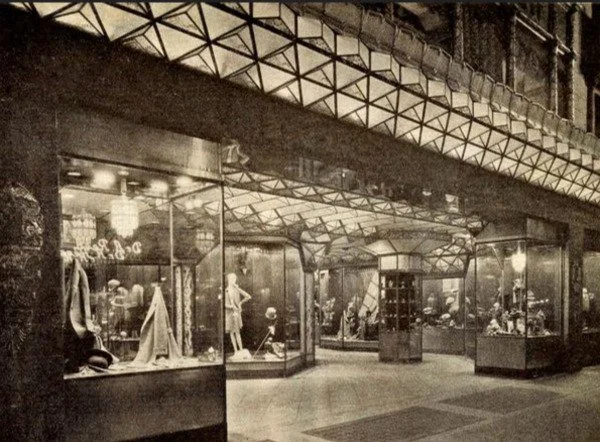
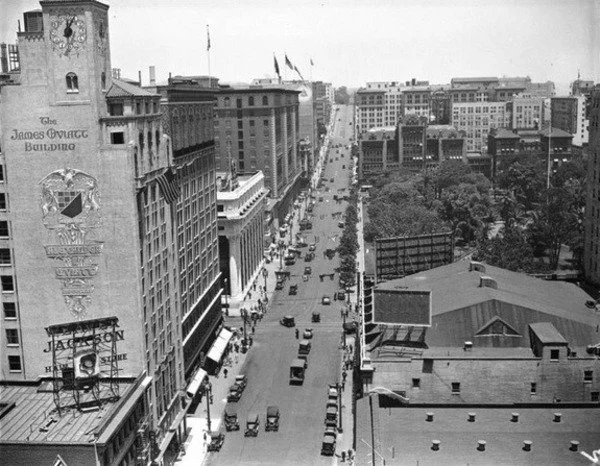
James Oviatt came to Los Angeles from Salt Lake City in 1909 with nothing, and made a fortune dressing other people. By the twenties he was sailing to Europe every summer to buy fabric. In 1925 he went to the Exposition Internationale des Arts Décoratifs in Paris, and whatever happened to him there, he never entirely came back from it.
He spent the next three years rebuilding it on Olive Street.
He ordered thirty tons of Lalique glass, the largest shipment of its kind ever to pass through the Panama Canal. He had a three-faced clock with chimes made in France and mounted it on the tower. He had a perfume made to sell in the store and had Lalique design the bottle.
On the roof he built himself a ten-room penthouse with a Turkish bath, a gym, a tennis court, practice golf links, and a pool filled with sand shipped from France so there would be a beach on it.
There weren’t enough bedrooms. His son slept in a small room off the kitchen, on the floor below.
When the scaffolding came down in May of 1928, the crowd on Olive Street saw the glass lit from behind for the first time — the color moving through it slowly, dark to pale and back, a sunset someone had gotten wired to a switch.
He called it the castle of our dreams. He lived in it for the rest of his life.
He had visited a moment, and then he built a replica and lived on top of it for forty-five years.
Almost from the beginning, the penthouse had been a place for parties, with movie stars and other fixtures of Los Angeles passing through. The building even acquired its own bit of lore: a light at the top meant something was happening upstairs.
Nearly a century later, it was our turn.
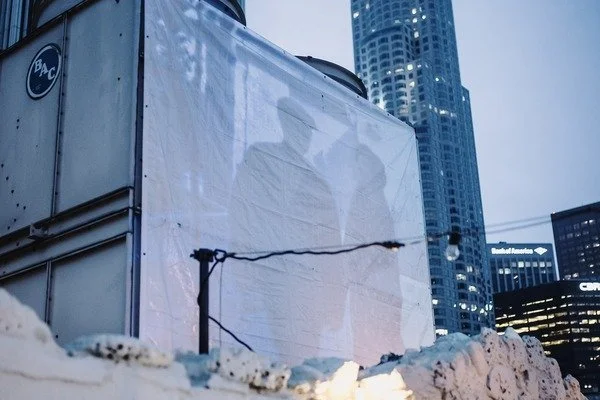
That night we projected Midnight in Paris on the rooftop.
Gil Pender is certain he was born too late. He walks through the present-day city imagining it in the twenties — Hemingway, Fitzgerald, Stein, cafés full of people making things that would turn out to matter. And then, impossibly, he gets there. He gets the actual twenties, the ones he’s been mourning.
And finds that the people living inside his golden age are dreaming about an earlier one. Adriana would rather be in the Belle Époque. Travel there and the people you meet wish they’d been born for the Renaissance.
Everyone wants to be somewhere else in time.
The golden age is always behind us. Which means it has never once been available to anyone.
We screened a film about a man homesick for a Paris he was never alive for, against the wall of a building made by a man homesick for one he’d actually seen.
We didn’t plan that. I’m still not sure whether it’s funny.
Here’s what I think is going on, and it has nothing to do with the past being better.
The past has already been curated. The present hasn’t.
What survives from 1925 is the Exposition — the glass, the lacquer, the photographs, the influence that traveled across an ocean and ended up on a roof in Los Angeles.
What reaches us has already been selected. The rest has faded into the ordinary texture of that year.
The present arrives with all of it still attached.
So of course it feels thinner. We’re comparing a finished cut to raw footage.
Which is why nobody recognizes a golden age from the inside. Nothing that has ever mattered to anyone felt historic while it was happening. It felt like a Tuesday. It felt like errands, and weather, and somebody running late.
⸻
Here’s the complication, and it’s why I don’t think nostalgia is the enemy.
Missing things isn’t dishonest. Some things really were better, and some are worth grieving, and an instinct toward permanence isn’t a character flaw in a culture that’s made almost everything temporary.
Hofer’s patients had real symptoms. Loss of appetite. Palpitations. Fever. A tendency to confuse the past with the present. They weren’t wrong that they were far from home.
They were just dying of it.
Oviatt wasn’t wrong that Paris in 1925 was extraordinary. He built something extraordinary out of missing it. He also built a house with no room in it for his kid.
The trouble starts when memory becomes evidence against the present.
When the old restaurant makes every new restaurant worse. When the record you grew up on prevents you from hearing the one being made now. When the city you remember becomes more real than the city outside the window.
When you get so good at recognizing what mattered that you forget something has to matter for the first time.
⸻
So what’s the opposite of nostalgia?
Not forgetting. I think it’s participation.
Sitting down at the table. Opening the bottle. Taking the photograph without knowing whether it’ll be any good. Wearing the thing until it becomes old, instead of buying somebody else’s old thing to tell you how to feel. Making traditions before anyone has agreed to call them traditions.
Just: go to the same place. Sit with the same people. Tell the same stories. Notice when somebody who came alone three weeks ago starts explaining things to somebody who came alone tonight.
Hofer prescribed one cure, and it wasn’t a medicine. Send them home.
We have the harder version, because the home in question isn’t a place. You can’t be sent to 1925, or to the year your friends were all still in the same city, or to whatever decade you’ve decided you should have been born into. Oviatt got closer than most people ever will, and he still only got a replica with imported sand on it.
There’s one more thing about that night.
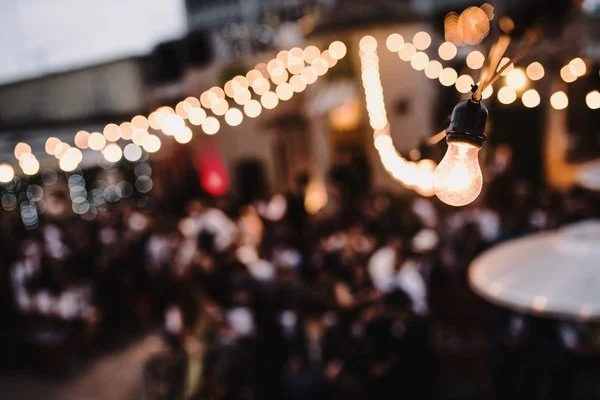
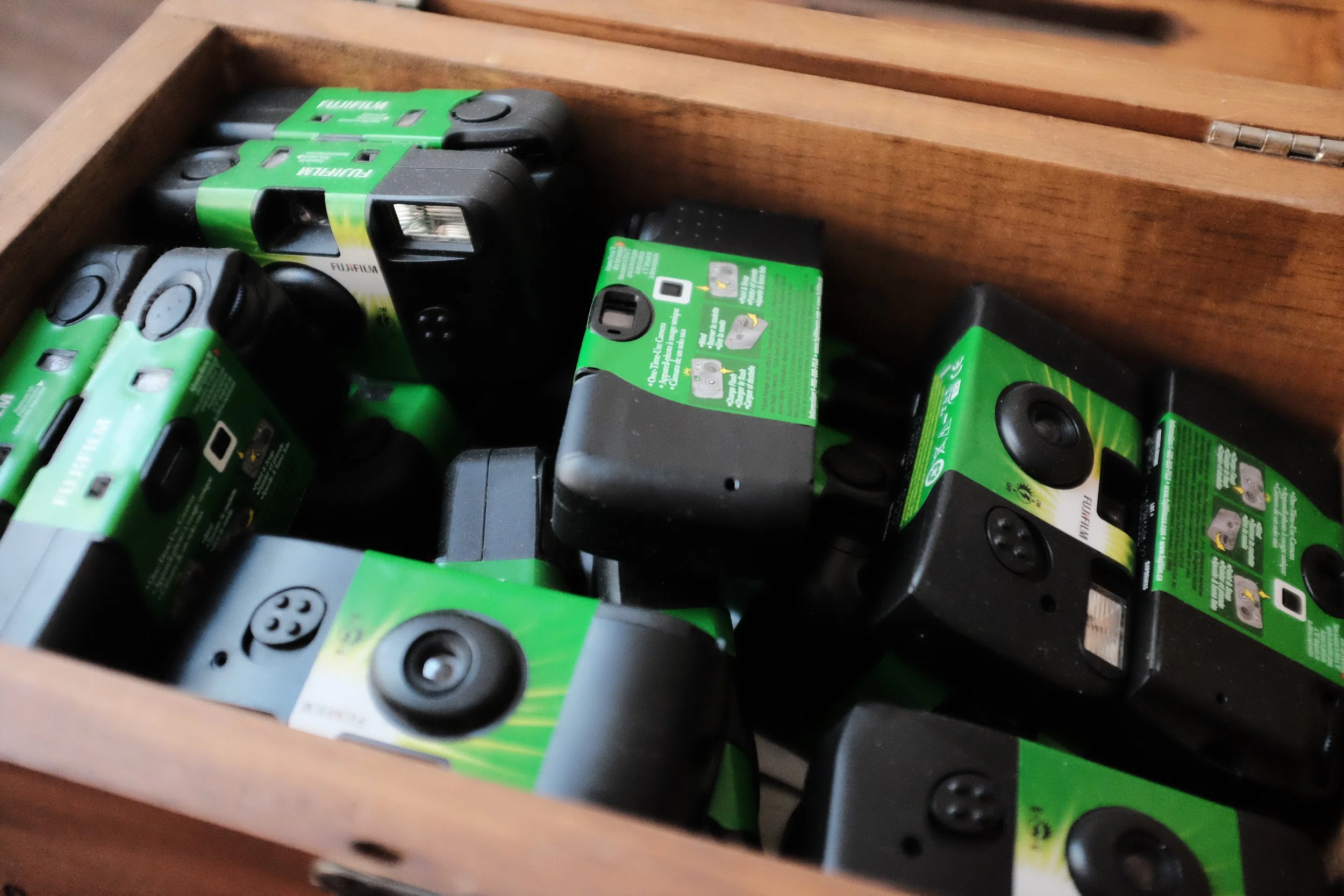
It was a surprise wedding. We told the photographers no posed shots, nothing that belongs in an album, and we left disposable cameras on the tables so everyone else could take whatever they wanted. We went to some trouble to make sure nobody would tidy it up.
The cameras are still in a chest in our apartment. Nobody has developed them.
Right now that night is still everything that happened. Develop them and it becomes a few dozen pictures, and whatever isn’t in the pictures starts, slowly, to stop having happened.
The golden age has plenty of time to become the golden age.
I’d rather be here while it’s still ordinary.